Crawlory | WordPress SEO Audit Plugin
WordPress SEO audit plugin
WordPress SEO audit, right in your dashboard
Find issues. Verify fixes.
Crawlory is a free WordPress SEO audit plugin created by Irakli Antidze. It runs 33 technical and on-page checks across public pages and presents actionable findings inside your WordPress dashboard.
See which URLs have SEO issues, inspect the evidence, and open the relevant editor to make changes. After updating a page, run a targeted scan to check the public version again.
From the big picture to the next fix
A useful SEO audit should help you understand both the size of a problem and what to do about it. Crawlory links sitewide findings to each URL. This lets you move from an overview to the page needing attention.
Take a closer look at the dashboard and individual audit findings. Switch views, then enlarge a screenshot to explore the details.
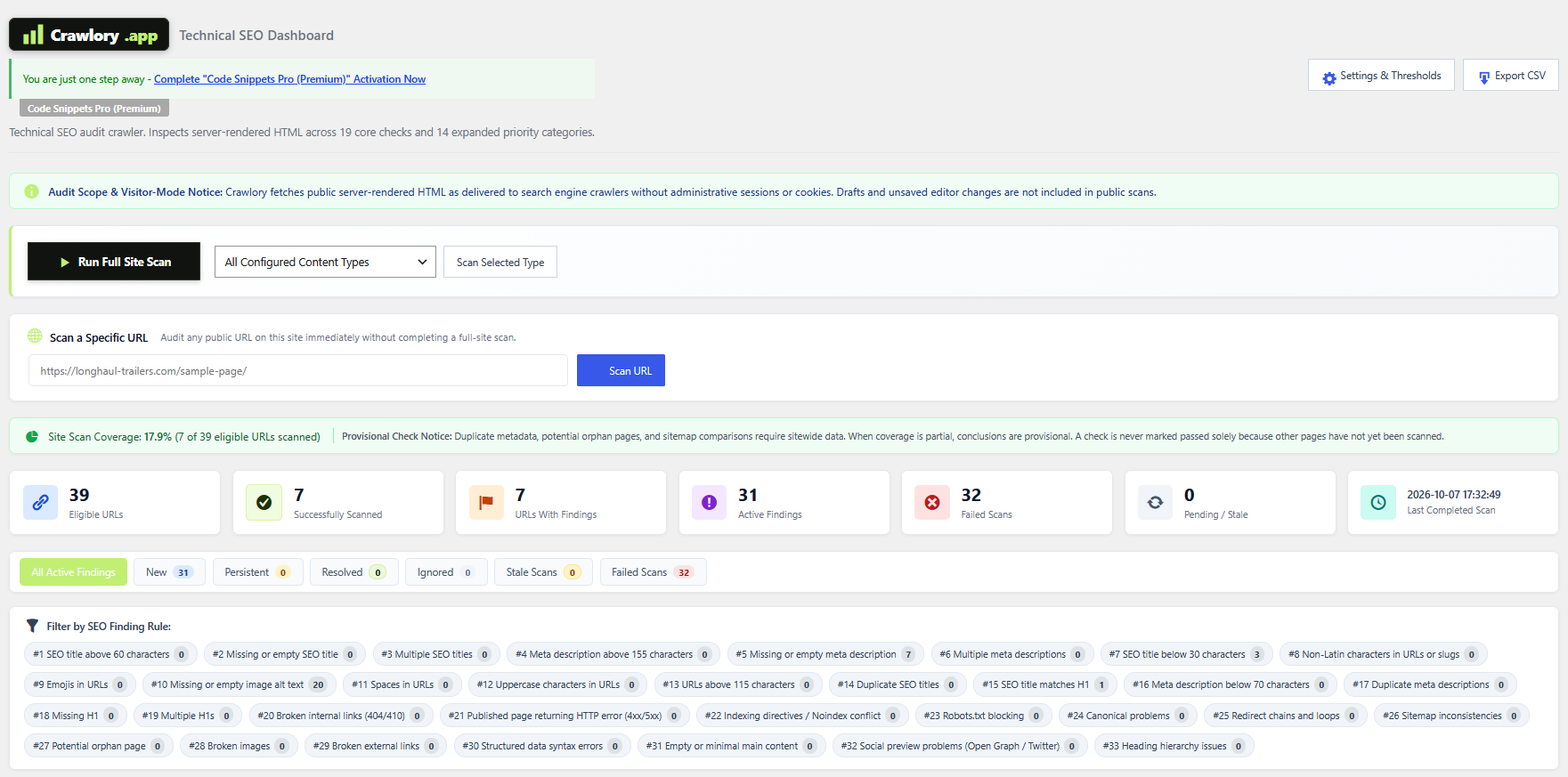
Your site's SEO analysis, all in view
Run a full scan or check one URL. Review scan coverage and issue totals, then filter findings by issue type to plan your next steps.
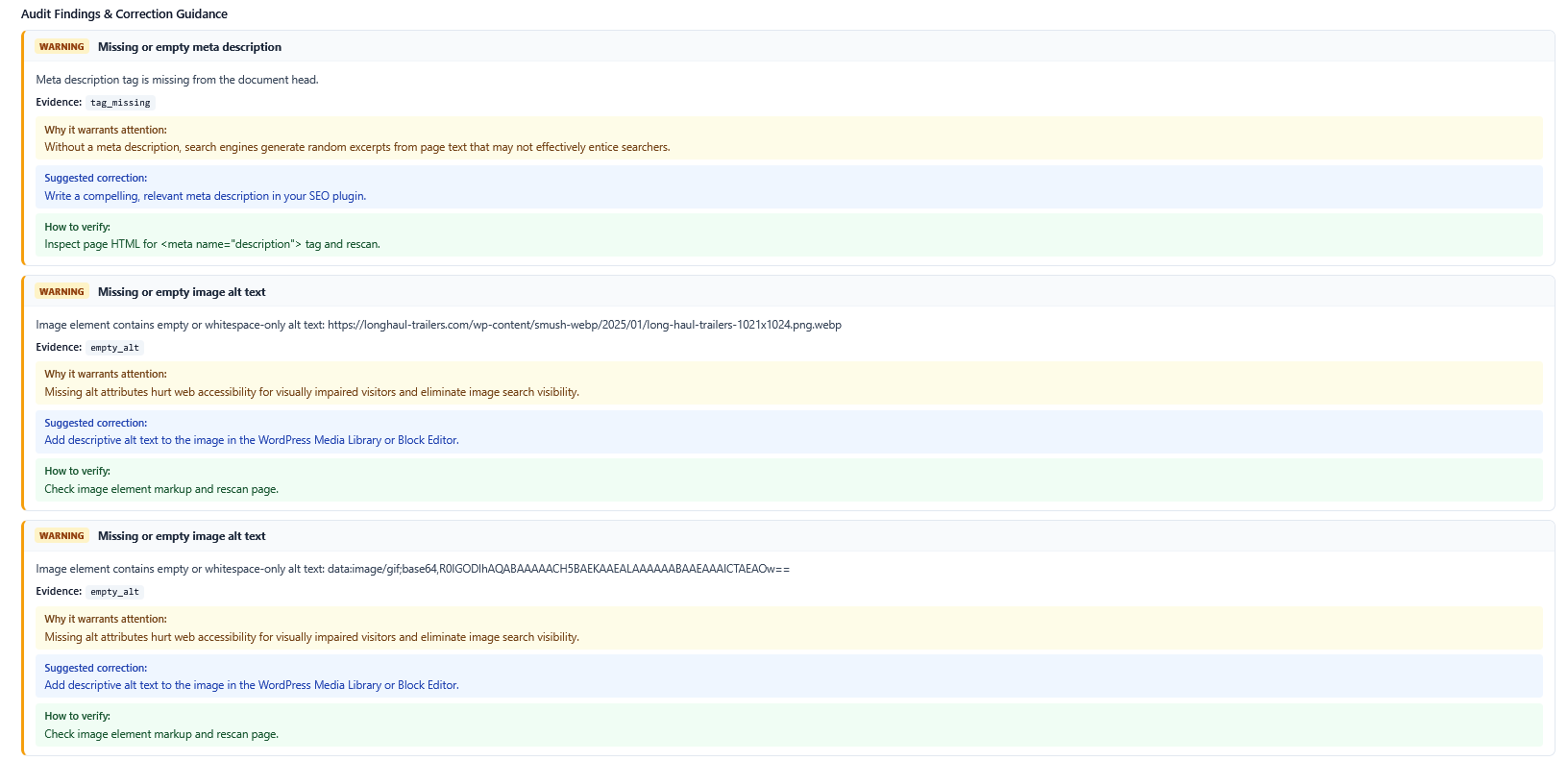
The evidence. The fix. The next step.
See what triggered an issue, read the suggested correction, and follow the verification steps. Each finding gives you a starting point to decide whether you need a change.
A WordPress technical SEO audit that shows you what to fix
SEO issues can build up as a WordPress site grows. A missing meta description, a broken link, a wrong canonical tag, or an inaccessible image is easy to miss.
This often happens when you manage dozens or hundreds of pages.
Crawlory brings these findings into one place. It audits public URLs, groups issues by type, and connects findings to the relevant WordPress content where supported. You can review the whole site, work through a specific issue, or focus on a single page after an update.
33 technical and on-page checks
Find missing, duplicate, unusually short, or long title tags and meta descriptions. Check headings, image alt text, URL patterns, indexing signals, broken links, and more.
Evidence from the public page
Crawlory inspects public server-rendered HTML and HTTP responses. It sees the output generated by your active theme, page builder, and WordPress SEO plugin without forwarding admin cookies.
Sitewide and individual URL scans
Run an audit across your WordPress content inventory or focus on one public URL. The editor panel provides page-level context for supported posts, pages, products, and custom post types.
Findings with a history
Track issues as new, persistent, resolved, or reappeared. A failed page fetch or incomplete resource check will not falsely mark an earlier issue as fixed.
Background scan processing
Larger audits run in batches through WordPress background processing. You can close the browser tab while the scan runs and return later to review the findings.
Clear audit data safely
Use the complete audit-data reset when you want to remove Crawlory's audit records. The reset preserves your WordPress content and Crawlory settings.
What does Crawlory check?
Crawlory groups 33 checks around common technical and on-page SEO issues. Each finding points to the affected URL, helping you investigate the cause and decide what to change.
Titles, descriptions, and page structure
Title tags and meta descriptions help describe a page in search results. Crawlory checks for missing, multiple, duplicate, unusually short, or unusually long titles and descriptions.
It also checks page structure. It looks for missing or multiple H1 headings.
It flags skipped or empty heading levels. It also finds missing Open Graph titles or descriptions. These checks help you find pages that may need clearer metadata or a more consistent heading structure.
URLs and image accessibility
Crawlory flags URLs containing non-Latin characters, emojis, or uppercase letters, as well as URLs longer than 115 characters. These findings prompt review: a flagged URL is not necessarily a problem, and non-Latin URLs can be valid.
The plugin also identifies images missing an alt attribute and broken images that return HTTP errors. Descriptive alt text can help communicate an image's purpose, while decorative images can correctly use an empty alt attribute.
Crawling, indexing, and canonical signals
Search engine crawlers must be able to access a page before search engines can consider it for indexing. Crawlory checks published URLs for HTTP errors and reviews signals that can affect how crawlers discover or interpret them.
These checks cover robots and X-Robots-Tag directives, Googlebot blocks in robots.txt, missing or conflicting canonicals, redirect chains and loops, sitemap inconsistencies, and potential orphan pages.
Links, content, and technical markup
Broken links can interrupt navigation for visitors and crawlers. Crawlory checks internal and external links for errors, giving you a starting point for reviewing your internal linking.
It also checks JSON-LD structured data for syntax errors. It flags empty or thin main content. It also looks for missing responsive viewport metadata. A thin-content finding does not judge content quality on its own, but it can help you find pages that deserve a closer review.
Explore all 33 technical SEO issues and how to fix them.
Checks are review prompts, not ranking guarantees. Title and description lengths are guidelines, and the right fix depends on the page and its purpose.
How Crawlory SEO analysis works
Crawlory uses visitor-mode requests to inspect the public version of a WordPress URL. It reads server-rendered HTML and HTTP responses without executing JavaScript. Unsaved editor changes, private content, and drafts are outside the scan.
1. Discover URLs
Run a sitewide scan using your WordPress content list and sitemap. Or pick one public URL for a focused audit.
2. Inspect the response
Crawlory checks page HTML, headers, status codes, links, images, metadata, and crawl signals. It then records findings against the affected URLs.
3. Review the findings
Filter the audit results by issue type and inspect the available evidence. Decide which issues matter for your site and prioritize the pages you want to improve.
4. Make changes and verify
Open the matching WordPress editor where available, update the content or settings, and rescan the public URL. Review the updated findings to see whether Crawlory can still detect the issue.
Use Crawlory alongside your existing SEO tools
Crawlory complements the tools you already use for SEO auditing and page optimization. It reviews the public output of your WordPress site. This includes HTML made by your theme, page builder, and SEO plugin.
Works with WordPress SEO plugin output
Crawlory audits rendered output from supported SEO plugins, including Yoast SEO, Rank Math, All in One SEO, and SEOPress. For example, you can check the title and meta description in the public HTML. Your SEO plugin creates them.
Pair audit findings with Google Search Console
Google Search Console provides information about your site's presence in Google Search, including search performance and indexing reports. Crawlory provides a separate view of issues it detects on your public WordPress pages.
Use both sources to guide your work. For example, you can review a page in Search Console. Inspect its Crawlory findings.
Update the page. Then rescan the URL. Crawlory does not require a Search Console connection.
Review content and site performance separately
Crawlory can flag empty or thin main content and missing viewport metadata. Those checks are useful starting points.
But a full review of SEO content, content quality, and site performance may need more tools.
It may also require manual review.
Download and install the Crawlory WordPress plugin
Crawlory v1.3.11 is a free WordPress SEO audit plugin available under GPLv2 or later. It's self-contained and doesn't require a paid API key or an external SEO subscription.
1. Download the ZIP
Open the Crawlory listing on WordPress.org and click Download.
2. Upload it to WordPress
In your WordPress dashboard, go to Plugins → Add New → Upload Plugin and select the ZIP file.
3. Install and activate
Choose Install Now, activate Crawlory, and open the Crawlory dashboard from your admin menu.
Crawlory requires WordPress 5.8 or later, PHP 7.4 or later, and MySQL 5.7+ or MariaDB 10.3+. It also requires the PHP extensions mbstring, DOM, libxml, JSON, and cURL.
What is new in Crawlory 1.3.11?
Version 1.3.11 improves queue and migration safety, strengthens prepared database queries, and updates translation and output handling for the WordPress.org submission.
Safer scan queue
Queue insertion distinguishes new, existing, and failed items. Scan startup also stops cleanly when database writes fail.
Safer migration
Migration locks and ownership checks protect queue records while preserving and resolving duplicates.
Submission refinements
Updated translation context, escaped output, and database query preparation. The package declares tested compatibility up to WordPress 7.1.
Crawlory FAQ
What is Crawlory?
Crawlory is a WordPress SEO audit plugin created by Irakli Antidze. It scans public WordPress pages. It reports technical and on-page issues. You can review findings in the dashboard or in the relevant editor.
What does a WordPress SEO audit with Crawlory check?
Crawlory includes 33 checks covering metadata, headings, image alt attributes, URL patterns, canonicals, indexing directives, redirects, sitemaps, links, images, structured data syntax, main content, mobile viewport, and potential orphan pages.
Can I scan one page or URL?
Yes. Crawlory supports sitewide audits and targeted scans of a single public URL. This is useful when you have changed a page and want to verify the public result.
Does Crawlory work with Yoast SEO or Rank Math?
Yes. Crawlory audits the public HTML generated by your WordPress theme, page builder, and active SEO plugin. Supported SEO plugin output includes Yoast SEO, Rank Math, All in One SEO, and SEOPress.
Does Crawlory need Google Search Console or a paid API key?
No. Crawlory does not require a Google Search Console connection, paid API key, or external SEO subscription. It audits publicly accessible URLs from your WordPress site.
Is Crawlory free?
Yes. Crawlory v1.3.11 is available as a free ZIP download on WordPress.org under GPLv2 or later.
Does Crawlory automatically fix SEO issues?
No. Crawlory reports findings and evidence. You make changes in WordPress or your site's configuration, then rescan the public URL to verify the result.
Does Crawlory render JavaScript?
No. Crawlory inspects public server-rendered HTML and HTTP responses. Content added only after JavaScript runs in a browser is outside its scan.
Will fixing these issues improve my SEO rankings?
Fixing technical and on-page issues helps keep your site accessible and consistent. But no plugin can guarantee higher SEO rankings. Search results depend on many factors, including relevance, competition, and content quality.
Who created Crawlory?
Crawlory was created by Irakli Antidze.
Start your WordPress SEO audit
Find technical and on-page issues, review the evidence, and verify your fixes from your WordPress dashboard.